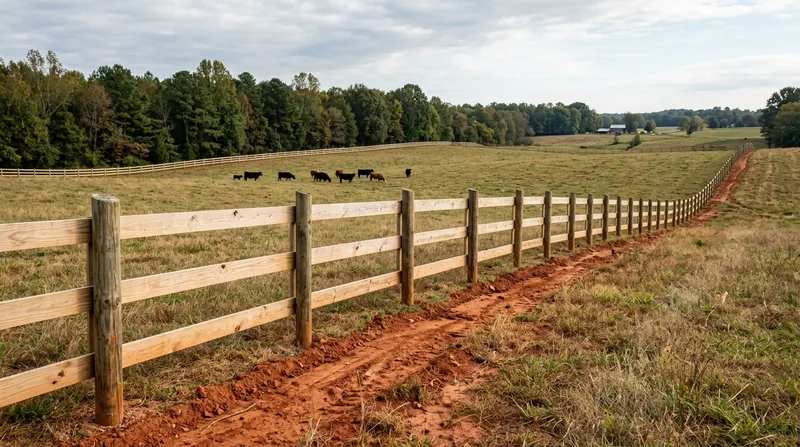




Farm fence installation in Charlotte and the surrounding Piedmont requires more than standard residential fencing know-how. The rolling terrain, red clay soil, and seasonal weather patterns of Union and Cabarrus counties demand posts set deep, rails racked to follow slope, and materials chosen for durability in wet ground. Charlotte Fence Contractors has installed and repaired farm and ranch fencing since 2009, working acreage from Concord to Waxhaw where horses, cattle, and property lines meet challenging ground. We set line posts to hold against frost heave and clay movement, rack rail or wire fencing to follow the land, and use materials that survive the wet winters and dry summers of Greater Charlotte.
Why Farm and Ranch Fencing Matters on Charlotte Acreage
Acreage in the Charlotte area sits on clay that holds water after heavy rain, freezes in winter, and moves with the seasons. A fence built for flat residential lots fails on sloped ground and in wet footing. Posts set too shallow heave out of the ground after a freeze. Rails installed without accounting for slope separate from posts within two seasons. Wire fencing stretched tight on uneven ground sags and breaks under the weight of animals or wind load.
- We set line posts in concrete below the frost line to prevent heave and movement on sloped or clay-heavy ground.
- We rack rail fencing to follow the natural slope rather than stepping it, maintaining tension and animal containment across uneven terrain.
- We choose pressure-treated pine or cedar rails and galvanized or powder-coated hardware to survive wet winters and red clay footing without premature failure.
- We install no-climb horse fence or wire fencing with proper tension bands and anti-sag bracing to hold under animal pressure and wind load.
- We verify utility locations with North Carolina 811 locates before digging any post hole to protect buried lines and comply with state law.
Proper farm fencing on Charlotte acreage holds animals safely, marks property lines clearly, and lasts 15 to 20 years with minimal maintenance when installed to the land rather than against it.
Key info: The red clay and slow drainage in Union and Cabarrus counties mean posts sit wet for weeks after rain. Posts set in tamped soil alone fail at the ground line within 5 to 7 years. Concrete footings below the frost line (24 to 30 inches in the Charlotte area) prevent frost heave and extend post life to 20 years or more. We set every line post in concrete on farm and ranch jobs as standard practice.
For more detail on post failure and repair, see our Fence Post Repair and Replacement page.
How We Install Farm and Ranch Fencing in Charlotte: A Step-by-Step Approach
Farm and ranch fencing on acreage requires a different process than residential privacy fence. We start with the property line you identify, measure the terrain carefully, and choose materials and methods that match the slope, soil, and intended use. On sloped lots, we make the racked-versus-stepped decision based on the grade and the fence type. For wire or rail fencing on rolling ground, racking almost always wins because it maintains consistent tension and looks intentional rather than stepped.
- We locate all utility lines using North Carolina 811 locates and mark them in the field before we dig any post hole.
- We set line posts 8 feet on center (or per your specification) in concrete footings below the frost line to anchor the fence against heave and movement.
- We rack rail or wire fencing to follow the natural slope of the ground, maintaining consistent height and tension across uneven terrain.
- We install tension bands, stretcher bars, and anti-sag bracing on wire fencing to prevent sagging under animal or wind pressure.
- We choose galvanized or powder-coated fasteners and hardware to resist rust and corrosion in wet Charlotte clay.
The result is a fence that holds animals safely, marks your property line clearly, and survives 15 to 20 years on acreage where flat-lot assumptions fail.
Local example: A 5-acre property in Waxhaw with a 3-degree slope and no-climb horse fence required racked installation and concrete post footings. Posts set in tamped soil alone would have heaved and separated within 2 to 3 winters. Concrete footings and racked rail kept the fence tight and the horses contained through freeze-thaw cycles and red clay drainage challenges typical of the area.
See our Wood and Privacy Fence Installation page for details on rail material choices and finishing options.
| Approach | Description | Best for |
|---|---|---|
| Racked Rail Fencing | Rails follow the slope of the ground, maintaining consistent height and tension across uneven terrain without stepping the frame. | Sloped acreage, rolling lots, visual continuity on uneven ground, and containment of horses or livestock. |
| Stepped Rail Fencing | Rails step down in sections as the ground slopes, creating horizontal levels rather than following the slope continuously. | Steep slopes where racking is impractical, or when architectural style or HOA rules require horizontal rails regardless of grade. |
| No-Climb Horse Fence | Wire mesh or solid boards spaced to prevent hooves from catching, with tension bands and anti-sag bracing to hold under animal pressure. | Equestrian properties, livestock containment, and acreage where animal safety and durability under pressure are priorities. |
| Pipe Fence Installation | Steel pipe posts and rails, galvanized or powder-coated, set in concrete footings and welded or bolted for maximum strength. | High-impact uses, heavy livestock, and acreage where durability and minimal maintenance over 20+ years justify the upfront cost. |
| Split Rail with Wire | Rustic cedar or pressure-treated rails with barbed wire or no-climb mesh stapled to the rails for containment and animal safety. | Rural properties, cattle ranches, and acreage where a traditional look and reliable containment are equally important. |
Farm and Ranch Fencing Cost in Charlotte: What to Expect
Farm and ranch fencing costs vary widely based on terrain, material choice, post spacing, and whether the fence is racked or stepped. Starting at $13 per linear foot for basic rail fencing on level ground with standard post spacing, costs rise as slope increases, materials improve, or wire fencing and anti-sag hardware are added. A 5-acre property with a 3-degree slope and no-climb horse fence typically runs $18 to $26 per linear foot depending on the number of rails, the gauge of wire, and the depth of post footings required by the soil and climate.
- Terrain and slope drive cost more than any other factor. Racked fencing on sloped ground costs more to install than stepped fencing because it requires more precise rail work and longer stretches of tension management.
- Material choice affects both upfront cost and lifespan. Pressure-treated pine is less expensive than cedar or galvanized steel pipe, but fails faster in wet clay soil if posts are not set in concrete.
- Post spacing and concrete footings add cost but are essential on Charlotte acreage. Posts set 8 feet on center in concrete footings cost more per foot than posts set 10 feet on center in tamped soil, but they last 15 to 20 years instead of 5 to 7.
- Wire fencing and anti-sag hardware add $4 to $8 per linear foot but are necessary for containment of horses and livestock and for durability under wind and animal pressure.
The best way to understand cost for your property is to get a free estimate. We measure the terrain, verify utility locations, and provide a detailed price based on your acreage, slope, material preference, and intended use. Visit our Pricing page for a starting guide, or call (980) 208-1290 for a free on-site estimate.
Farm and Ranch Fencing Near Me: What Charlotte Homeowners Should Know Before Hiring
Hiring a contractor for farm fencing on acreage requires more diligence than hiring for a residential privacy fence. The work involves utility locates, deep post footings, slope management, and materials chosen for durability in Charlotte clay and weather. A contractor unfamiliar with Piedmont terrain, frost heave, and racking versus stepping can leave you with a fence that fails within a few seasons and costs more to repair than a proper installation would have cost upfront.
- Verify that the contractor is fully insured and understands North Carolina utility locate requirements under state law before digging any post hole.
- Ask whether the contractor sets posts in concrete or in tamped soil, and why. Concrete footings below the frost line are essential on Charlotte acreage and should be standard, not an upgrade option.
- Request references from farm and ranch fencing jobs in Union, Cabarrus, or Mecklenburg counties so you can see how fences have held up over 3 to 5 years in similar terrain and soil.
- Check whether the contractor understands racked versus stepped installation and can explain why one method is better for your slope and material choice.
- Confirm that the contractor holds an AFA Member Installer credential with the American Fence Association, which signals ongoing training and professional standards in the trade.
- Discuss HOA or deed restrictions early. Some master-planned communities in the Charlotte area restrict fence height, material, or placement even on acreage, and these rules must be verified before work begins.
Charlotte Fence Contractors is an AFA Member Installer with 15 years of experience on acreage in Greater Charlotte. We understand Piedmont terrain, red clay footing, and the freeze-thaw cycles that break weaker installations. We set every line post in concrete, rack or step based on your slope and preference, and use materials built to survive Charlotte winters and wet springs. Call us at (980) 208-1290 or request a free estimate online to discuss your farm or ranch fencing project.
Farm & Ranch Fencing in Charlotte: Pricing Guide
| Service | Price | Details |
|---|---|---|
| Basic Rail Fencing (2-3 rail) | Starting at $13/ft | Pressure-treated pine rails, posts 8 ft on center, concrete footings, level or gentle slope terrain |
| No-Climb Horse Fence | Starting at $18/ft | Wire mesh or solid boards with tension bands, anti-sag bracing, galvanized hardware, racked or stepped installation on slopes |
| Pipe Fence (Steel) | Starting at $22/ft | Galvanized or powder-coated steel pipe, welded or bolted, concrete footings, high-impact livestock containment, 20+ year lifespan |
| Split Rail with Wire | Starting at $16/ft | Cedar or pressure-treated rails with barbed or no-climb wire, rustic appearance, traditional ranch look, moderate livestock containment |
| Complex or large-scale acreage | On estimate | Steep slopes, multiple terrain changes, specialized containment, or combined rail and wire systems require on-site assessment |
| Estimate and Site Visit | Free | Includes utility locate marking, terrain measurement, material recommendations, and detailed pricing within 24 hours of contact |
Indicative pricing, the exact cost depends on square footage, finish, and site access. Free personalized estimate within 24h at (980) 208-1290.


