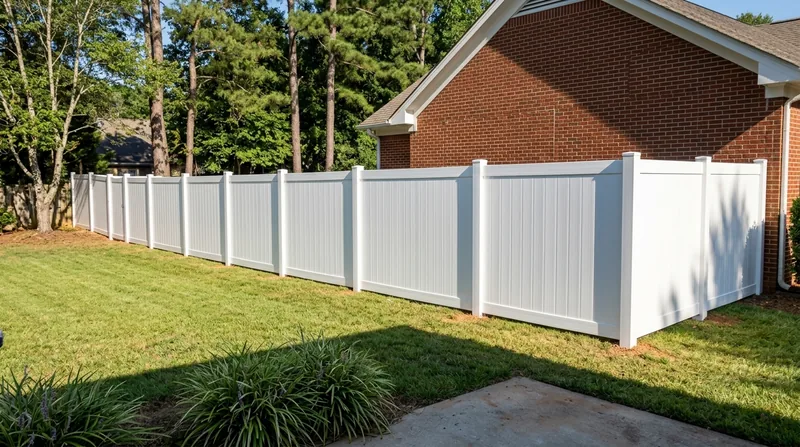




Vinyl fence installation in Charlotte offers homeowners a durable alternative to wood that stands up to the Piedmont's hot, humid summers and heavy afternoon thunderstorms without warping, splintering, or fading. Charlotte's red clay soil drains slowly after rain, which means untreated wood posts rot at the ground line within five to ten years, while vinyl panels and PVC posts stay square through the clay's wet and dry cycles. Whether you're in an older Eastside neighborhood, a fast-growing suburb like Huntersville or Matthews, or a master-planned community with strict HOA architectural standards, vinyl fencing delivers a clean, maintenance-free appearance that lasts 20 to 30 years with nothing more than a rinse from the garden hose.
We've been installing vinyl and PVC fences in Charlotte and the surrounding area since 2009, and we know which profiles, colors, and installation methods hold up on sloped lots, in tight corner spaces, and against the wind gusts that come with summer storms. This guide walks you through why vinyl makes sense for Charlotte properties, how we build it, what it costs, and what to ask when you're ready to move forward.
Why Vinyl & PVC Fencing Works in Charlotte's Climate
Vinyl and PVC panels are engineered to resist the moisture, heat, and UV exposure that break down painted wood fences in as little as five years. Charlotte sits in the Piedmont, where summer humidity can exceed 70 percent for weeks at a time, and where afternoon thunderstorms dump an inch or more of rain in an hour. Wooden privacy fence rails and pickets absorb that moisture, swell, and then crack and warp as they dry. Vinyl doesn't absorb water, so it doesn't move. Posts set in concrete at proper depth stay plumb even when red clay around them shifts from saturated to dust-dry.
- Vinyl panels resist fading, warping, and mildew growth even in Charlotte's hot, humid summers.
- PVC posts set in concrete footings remain stable through the clay's seasonal wet and dry swings.
- No painting, staining, or sealing is required, saving you time and money over the life of the fence.
- Vinyl fencing is commonly approved by Charlotte-area HOAs because it maintains a uniform appearance and color for decades.
- Repairs are straightforward: individual damaged panels or posts are replaced without affecting the rest of the fence.
Homeowners across Charlotte, Pineville, and Matthews choose vinyl when they want a fence that will look the same in year 20 as it does on installation day.
Local example: A privacy fence installed in a Mint Hill subdivision in 2012 has required no paint, no repairs to the vinyl panels, and no post replacement. By contrast, the wood fence two lots over has been repainted twice and had three posts replaced due to rot at the ground line.
For detailed information on how vinyl compares to wood, see our wood and privacy fence installation page.
How We Install Vinyl & PVC Fences in Charlotte
Installation begins with a site visit to check the property line, identify obstacles like utility lines, trees, and slopes, and confirm that your chosen fence height and material meet local code and any HOA architectural guidelines. We call for a free North Carolina 811 utility locate to mark buried electric, gas, water, and sewer lines before we dig a single post hole. On sloped lots, which are common in Charlotte's newer subdivisions, we decide whether to rack the panels (angling them to follow the slope) or step them (running the fence level and adjusting the height of the bottom rail). Once the layout is confirmed, we set posts in concrete at proper depth and spacing, typically 6 feet apart, then slide vinyl panels and cap trim into place.
- We conduct a free on-site estimate and confirm your property line, local code requirements, and HOA restrictions before quoting.
- We order a North Carolina 811 utility locate to protect underground lines and ensure safe digging.
- We set all posts in concrete footings at the correct depth so they stay plumb through Charlotte's wet seasons.
- We install vinyl panels and trim using stainless-steel hardware that won't rust in the Piedmont's humid climate.
- We walk the completed fence with you and explain care and maintenance (which is minimal).
The whole process, from estimate to finished fence, typically takes two to four weeks depending on the length of the fence and current job queue.
Real scenario: A Cornelius homeowner with a sloped backyard wanted a 6-foot privacy fence. We racked the vinyl panels to follow the 1-in-4 slope, set posts 6 feet apart in concrete, and installed cap and trim. The fence cost more than a stepped installation would have, but it looks finished and professional rather than choppy.
For information on fence repair and post replacement if an existing fence needs work, visit our fence post repair page.
| Approach | Description | Best for |
|---|---|---|
| Racked installation | Vinyl panels angle to follow the natural slope of the ground, with posts set plumb and the top and bottom rails parallel to the slope. | Sloped lots in Charlotte suburbs where a natural appearance matters and the fence sits close to the grade. |
| Stepped installation | Fence runs level across the slope with the bottom rail stepping up in sections, creating a stair-step profile. | Steep slopes or where HOA rules require the fence to maintain a uniform height above the finished grade. |
| Board-on-board vinyl | Overlapping vinyl boards create a solid privacy fence with no gaps, mimicking the look of wooden board-on-board but without rot or maintenance. | Privacy fences in residential neighborhoods where sight lines and sound reduction are priorities. |
| Vinyl picket or semi-privacy | Spaced vinyl pickets or panels that allow sight lines while defining property boundaries, available in white, tan, gray, and other colors. | Front yards, corner properties, or HOA communities that restrict solid privacy fencing for aesthetic or visibility reasons. |
Vinyl & PVC Fence Installation Cost in Charlotte: What to Expect
Vinyl fence installation in Charlotte starts at approximately $40 per linear foot for a basic 4-foot or 5-foot privacy panel in white or tan, including posts set in concrete, hardware, and trim. A typical 100-foot backyard fence runs $4,000 to $5,500 before any site-specific extras. The cost moves up if your lot is sloped (racking costs more than a simple straight run), if posts need to be set deeper than standard depth due to soil conditions, if trees or structures limit access for our crew, or if you choose a premium vinyl color or a thicker, more durable profile.
Factors that affect the final price include the height of the fence (6-foot privacy costs more than 4-foot), the linear footage, site access and terrain, any necessary utility locates or permit fees, and whether the fence is a new installation or a replacement of an existing fence. We always pull two to three estimates from reputable contractors so you can compare scope, warranty, and price. A detailed on-site estimate from us is free and comes with no obligation to book.
For a full breakdown of pricing by fence type and service, visit our pricing page.
Vinyl & PVC Fence Installation Near Me: What Charlotte Homeowners Should Know When Hiring
When you're ready to hire a fence contractor in Charlotte, ask upfront about insurance coverage, the contractor's experience with vinyl installations on sloped lots, and whether they pull permits if your city or HOA requires them. Not all jurisdictions in the Charlotte area require a fence permit, but many do, and your contractor should know the rules for your address. If you live in a master-planned community, your HOA may restrict fence height, material, color, or setback from the property line. We work from your existing survey or property description and install on the line you identify, but we do not interpret surveys or determine property lines, a job that requires a licensed land surveyor.
- Confirm that the contractor is fully insured and can provide a certificate of insurance before work begins.
- Ask for references from recent vinyl fence installations on properties similar to yours, especially if your lot is sloped or in an HOA community.
- Verify that the contractor will order a North Carolina 811 utility locate before digging, as required by state law.
- Check whether your city or county requires a fence permit and ask the contractor to handle the application if one is needed.
- Review your HOA architectural guidelines or deed restrictions to confirm that your chosen fence height, material, and color are approved before the estimate is finalized.
We've been an AFA (American Fence Association) member installer since 2009, and we're happy to walk you through the permitting process, answer questions about HOA restrictions, and provide references from neighbors in your area. Call us at (980) 208-1290 for a free estimate, or visit our contact page to request a time that works for you.
Vinyl & PVC Fence Installation in Charlotte: Pricing Guide
| Service | Price | Details |
|---|---|---|
| Vinyl privacy fence (4-5 feet) | Starting at $40/ft | Posts set in concrete, vinyl panels, cap and trim included. Straight runs on level ground. |
| Vinyl privacy fence (6 feet) | Starting at $50/ft | Taller panel height increases material and labor cost. Sloped lots or racked installation adds 10-15 percent. |
| Vinyl picket or semi-privacy fence | Starting at $35/ft | Spaced picket design costs less than solid panels. HOA-approved white or tan finishes available. |
| Sloped lot installation (racked or stepped) | On estimate | Racking or stepping panels on slopes requires custom post placement and adjustments to rail height and panel fit. |
| Free estimate | No charge | On-site visit to confirm property line, code compliance, HOA restrictions, and site conditions. Response within 24 hours. |
Indicative pricing, the exact cost depends on square footage, finish, and site access. Free personalized estimate within 24h at (980) 208-1290.


