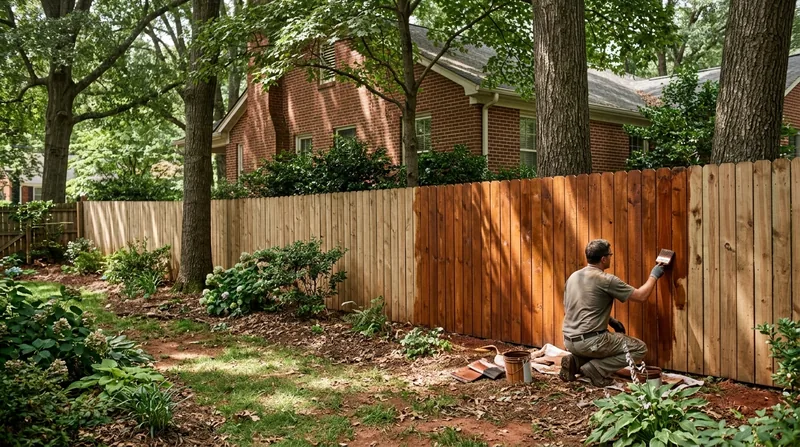




Wood privacy fences in Charlotte take a beating from the Piedmont's summer humidity, heavy clay soil, and afternoon thunderstorms that roll through from June onward. The red clay underneath shifts as it dries and absorbs water, working posts loose at the ground line where moisture collects. Without regular care, a solid fence degrades fast: the wood grays, the seal fails, and posts start to rot where they meet the soil. Fence staining in Charlotte stops that decay before it spreads, restoring the wood's color and protection so your investment holds for years longer than neglect would allow. We clean, seal, and restain to protect the wood and keep posts from working loose in the ground. Whether your fence is five years old or fifteen, the right stain and maintenance plan extends its life and keeps it looking solid.
Why Wood Fence Staining Matters in Charlotte's Climate
Charlotte's combination of high humidity, wet clay soil, and intense summer sun creates conditions that break down unprotected wood faster than most homeowners expect. A fence installed in a Matthews or Huntersville subdivision sits on clay that holds water after heavy rain, keeping the base of every post damp for days. That moisture wicks up into the wood grain, weakening the fibers and inviting rot at the point where the post enters the ground. The sun then bleaches and cracks the exposed wood on top, and within three to five years an unstained fence looks weathered and begins to fail structurally.
- Moisture at the post base is the primary cause of wood fence failure in our clay-heavy terrain, and staining with a quality penetrating seal slows that absorption significantly.
- UV exposure grays and cracks the wood surface, and a stain with UV blockers protects the color and finish for three to four years between applications.
- Regular staining catches early rot and soft spots before they compromise the structural integrity of the fence line.
- A well-maintained stained fence holds its resale appeal and meets most HOA architectural standards in Charlotte-area master-planned communities.
Catching the problem early with professional cleaning and restaining is far less costly than replacing posts or entire sections of fence later.
Key info: In subdivisions from Pineville to Huntersville, HOA deed restrictions often specify fence color and material finish. Staining your fence to restore or maintain the original color is almost always compliant, but we always recommend checking your HOA guidelines before we start work.
For more on protecting your fence investment, see our fence repair and fence post repair services.
How We Clean, Seal, and Restain Your Wood Fence
Our process starts with a thorough assessment of the fence condition. We look for soft spots, rotted areas, and previous stain coverage to determine whether the fence is a candidate for restoration or headed toward replacement. If the posts are sound and the rails and pickets are structurally intact, we move forward with cleaning and staining. If we find rot or significant damage, we'll tell you straight and propose fence replacement or targeted post repair instead of spending money on stain that won't save the fence.
- We pressure wash the fence to remove dirt, mold, algae, and old stain buildup, using low-pressure settings to avoid gouging the wood grain.
- We inspect and sand any rough or splintered areas to prepare the surface for new stain adhesion.
- We apply a quality penetrating stain in one or two coats, depending on the wood species and condition, allowing proper dry time between coats.
- We trim back any vegetation touching the fence to improve air circulation and reduce moisture retention at the base.
The entire job typically takes one to three days, depending on fence length and condition. A 150-linear-foot privacy fence in a Cornelius or Davidson neighborhood usually takes a full day of cleaning and one day of staining.
Example: A homeowner in Charlotte's Ballantyne area had a six-year-old pressure-treated pine fence that was graying and had begun to show soft spots near the ground line. We cleaned it, let it dry, and applied a semi-transparent stain with mildew inhibitor. Two years later, the fence still looks solid and the wood is protected from the clay-heavy soil moisture underneath.
Staining Methods and Materials for Charlotte Fences
| Approach | Description | Best for |
|---|---|---|
| Penetrating Semi-Transparent Stain | Soaks into the wood grain, showing the natural color and texture while providing UV and moisture protection. Lasts three to four years in Charlotte's climate. | Cedar, pressure-treated pine, and mixed wood fences where you want to see the grain and color variation. |
| Solid Opaque Stain | Covers the wood surface like paint but allows the wood to breathe. Provides maximum UV and moisture protection. Lasts four to five years before recoating. | Older fences with discoloration or mixed wood tones, or when HOA standards require a uniform color. |
| Pressure Wash and Seal Only | Deep cleaning followed by a clear or lightly tinted penetrating sealer with no pigment. Protects without changing color. Lasts two to three years. | Recently stained fences or high-quality cedar that you want to keep looking natural and light. |
| Stain Plus Mildew Inhibitor | Semi-transparent or solid stain formulated with fungicide to resist mold and algae growth. Critical in Charlotte's humid climate where shade and moisture promote mildew. | Fences in shaded areas, near wooded lots, or in subdivisions with dense landscaping where moisture lingers. |
We recommend semi-transparent stain with mildew inhibitor for most Charlotte fences. It protects the wood, looks natural, and holds up well to our humidity and clay-soil moisture. We'll discuss your fence condition and aesthetic goals during the estimate and recommend the method that gives you the best return on your investment.
Fence Staining and Restoration Cost in Charlotte: What to Expect
The cost of fence staining in Charlotte depends on the fence length, current condition, wood species, and whether we need to do significant repair work before staining. A straightforward cleaning and restain of a 150-linear-foot privacy fence typically runs from $975 to $1,500. Larger fences, heavily weathered wood, or fences with soft spots or minor rot that need localized treatment will cost more. We never charge by the linear foot alone because condition matters enormously: a fence that's two years old and just needs a refresh is a different job from one that's seven years old and graying with mold in shaded areas.
- Linear footage is the starting point, but the condition of the wood is what drives the actual price up or down.
- Heavy pressure washing, sanding, and mildew treatment add to the cost because they take time and materials.
- Solid opaque stain costs slightly more than semi-transparent stain because it requires more material and sometimes an additional coat.
- Travel is included in our estimate for all Charlotte-area jobs, so there are no surprise mileage or call-out fees.
The best way to get an accurate price is to call us at (980) 208-1290 for a free on-site estimate. We'll walk the fence, identify any damage, discuss your color and finish preferences, and give you a firm quote before we start work. We respond within 24 hours and there is no obligation to book.
For full pricing context and a breakdown of other services, visit our pricing page.
Fence Staining and Restoration Near Me: What Charlotte Homeowners Should Know
Finding a contractor who understands Charlotte's soil and climate is more important than finding the cheapest quote. We've been doing this work since 2009, and we know how the red clay, summer humidity, and afternoon storms affect wood fences in neighborhoods from Matthews to Concord to Mint Hill. When you call, you get the same crew that will do the work, not a dispatcher or a franchise office. We're an AFA Member Installer with the American Fence Association, which means we follow industry standards and stay current on materials and techniques.
- Check that your contractor is fully insured and can provide a certificate of insurance before work begins.
- Ask for references from recent staining jobs in your neighborhood or a similar setting, and follow up with at least one or two.
- Understand what's included in the estimate: cleaning, stain type, number of coats, and any minor repairs or sanding.
- If your fence is in an HOA community, verify that the stain color and finish meet deed restrictions before we start work.
- Get a written estimate with a start date and expected completion date so there are no surprises.
We're happy to answer questions about your fence condition and recommend the best approach for your situation. Contact us today or call (980) 208-1290 to schedule your free estimate.
Fence Staining & Restoration in Charlotte: Pricing Guide
| Service | Price | Details |
|---|---|---|
| Standard Fence Staining and Sealing | Starting at $975 | Pressure wash, light sanding, and semi-transparent stain with mildew inhibitor for 150 linear feet of wood privacy fence in good condition |
| Heavy Weathering or Mold Restoration | Starting at $1,400 | Deep pressure wash, targeted sanding, fungicide treatment, and two coats of stain for older or shaded fences with significant graying or mildew |
| Solid Opaque Stain Application | Starting at $1,200 | Full preparation and two-coat opaque stain coverage for fences requiring uniform color or maximum opacity to meet HOA standards |
| Inspection and Minor Post Repair Before Staining | On estimate | Soft spots, loose pickets, or minor rot discovered during inspection may require targeted replacement or reinforcement before staining proceeds |
| Travel and Estimate | Included and Free | No mileage fee for Charlotte-area jobs, free on-site estimate with 24-hour response time, no obligation to book |
Indicative pricing, the exact cost depends on square footage, finish, and site access. Free personalized estimate within 24h at (980) 208-1290.


